
NAFS
TAZKIYAH AN NAFS
Class 3
NAFS AL LAWWAAMAH
The Blaming Soul - Taking yourself to account, and finding the way back
We Track Everything, Except Ourselves
Every Sunday, your phone sends you a message: "Your screen time was up 23% this week."
Your watch counts your steps. Your banking app shows every rupee, dirham or dollar you spent. Your fitness app knows your calories, your sleep, your heart rate. Your boss checks your targets every month.
We measure almost everything in our lives.
But when was the last time you sat down and checked your soul? How many times did I lie today or this week? How many prayers did I pray with my heart, not just my body? Who did I hurt? What did I do only to be seen?
Most of us never ask. Not because we don't care, but because it is uncomfortable. It is easier to look at a step count than to look at yourself.
Allah repeatedly encourages us to reflect and think deeply about ourselves. The word yatafakkarun (they reflect) appears 17 times in the Quran. Scholars say, “Reflection is like a lamp for the heart—without it, the heart becomes dark. And when we stop reflecting, our lives can feel empty and without direction.
Why Should We?
One might ask: “Is all this effort really necessary?” Think about the alternative.
Life can easily become repetitive —eat, sleep, work, chores, prayer—and before you know it, another year has passed. Without reflection, life can pass us by without much meaning or growth.
The "autopilot" mode of living makes us less productive and less happy which eventually leads to ungratefulness . Yes, reflecting takes work—but the reward is a meaningful life. It helps us live with intention, grow as a person, and feel satisfied with the effort we’re putting into our time in this world.
In Class 2, we found our diseases. Today we learn the daily habit that keeps the heart healthy. Muhaasabah, taking yourself to account. And we learn what to do when the account shows that we have failed, Tawbah, the way back.
The Gift of the Blaming Soul
Remember the oath from Class 1:
"And I swear by the self-blaming soul." (Surah al-Qiyamah 75:2)
Allah swears by this soul because it is a sign of life. A dead heart sins and feels nothing. A living heart sins and feels a sting. That sting is a gift. It is our alarm inside, telling you that you have left the road.
But as we said, there are two kinds of self-blame, and they lead to opposite places:
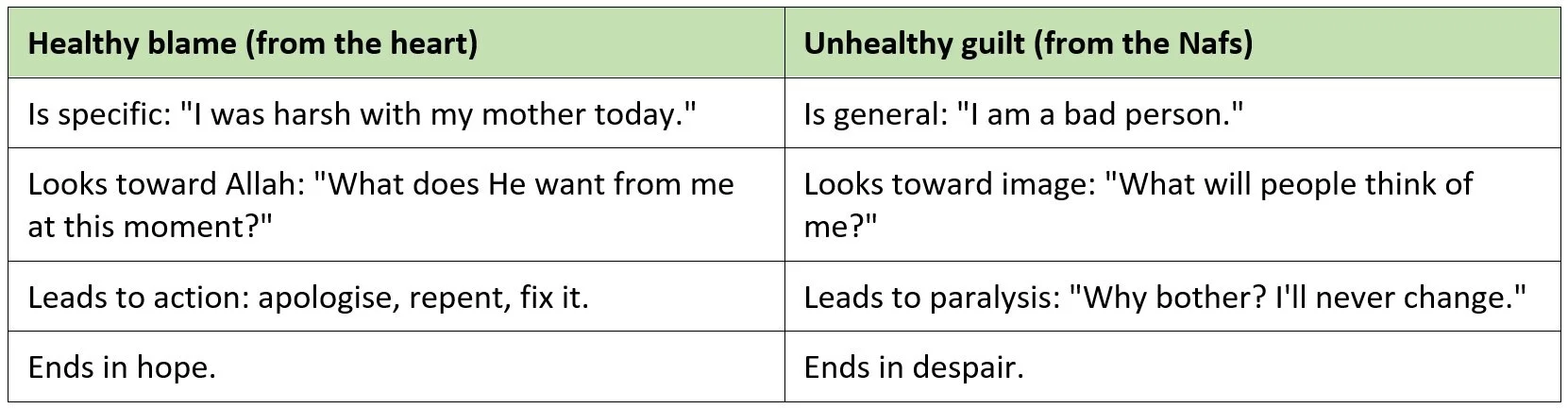
Shaytaan cannot always stop you from feeling bad about a sin. So he tries to make you feel so bad that you give up. Despair is not humility. It is one of his oldest tricks.
Muhaasabah
Taking Yourself to Account
Allah commands every believer to do this: "O you who believe, fear Allah, and let every soul look at what it has sent forward for tomorrow. And fear Allah. Indeed, Allah is fully aware of what you do." (Surah al-Hashr)59:18
"Let every soul look." Not look at others. Look at what it has sent ahead. Every day we send something forward to the next life: words, deeds, intentions. Muhaasabah is simply stopping to check what we sent today.
'Umar ibn al-Khattab said, Take account of yourselves before you are taken to account. Weigh your deeds before they are weighed for you. For it is easier for you to take account of yourselves today than tomorrow. (Reported by at-Tirmidhi after hadith 2459, and Ibn al-Mubarak in az-Zuhd)
The idea is simple. A student who checks his own work before the exam is calm on the day of results. The one who never checks gets a shock. The Day of Judgement will be light for those who made the right decisions here. Al-Hasan al-Basri said exactly this:
The believer is in charge of his own soul, taking it to account for the sake of Allah. The reckoning on the Day of Judgement will only be light for people who took account of themselves in this world, and it will only be heavy for people who took this matter without taking account.
And how strict should we be? The Tabi'i Maymun ibn Mihran gave a picture that every businessperson understands:
A servant will not be among the people of taqwa until he takes account of himself more strictly than a partner takes account of his business partner. Maymun ibn Mihran, reported by at-Tirmidhi after hadith 2459
Think how carefully you would check the accounts if your business partner handled your money. Now think how carefully you check your own soul.
Two kinds of muhasabah
Ibn al-Qayyim explains in Ighāthat al-Lahfān that muhasabah happens at two times: before an action and after it.
Before the action, stop at your intention for a moment. Al-Hasan al-Basri said: "May Allah have mercy on a servant who pauses at his intention. If it is for Allah, he goes ahead. If it is for other than Allah, he holds back." Before you post, speak, give, or reply, ask: Why am I doing this, and for whom?
After the action, Ibn al-Qayyim says a person should check three things:
Duties where I fell short. Did I pray, but with my mind elsewhere? Did I give my family their right?
Things I did that were better left. A word I should not have said. A look I should not have taken. An hour I should not have wasted.
Ordinary things, and why I did them. Eating, working, buying, posting: did I do them for Allah and with good intention, or only out of habit and for the world?
This takes five minutes. Done every night, it changes a life.
When you cannot see your own faults
In Class 2 we learned that the nafs hides its own faults. So how do we find them? Ibn al-Jawzi gives practical methods in Disciplining the Soul. Here are four of them:
Ask a wise friend to tell you your faults, and thank him when he does. Do not argue. If you get defensive, he will never tell you again.
Listen to your enemies. A friend hides your faults; an enemy looks for them. Even unfair criticism often contains a piece of truth.
See your habits in someone else. Imagine another person behaving exactly like you. Would you admire it? Then keep it. Would it annoy you? Then leave it.
Read the lives of the righteous and compare your actions with theirs. Next to them, even our "good" days look small.
Please join our free online certificate course “MUSLIM MIRROR”, to learn more about the importnace, and how to take stock of ourselves, traits that Allah likes and dislikes. https://learn-islam.org/muslim-mirror (available online now, register and learn).
Note these are not part of the ongoing course, it is an independent course that can be done at your own pace and at your own convenience.
Tawbah
The Way Back
Muhasabah shows you the problem. Tawbah is the solution. And Allah opens this door wider than we can imagine, Allah says,
"Say: O My servants who have transgressed against themselves, do not despair of the mercy of Allah. Indeed, Allah forgives all sins. Indeed, He is the Forgiving, the Merciful." (Surah az-Zumar 39:53)
Notice who Allah is speaking to: not the righteous, but those who transgressed. And notice how He calls them: "O My servants." Even after their sins, they are still His.
The Prophet ﷺ said, "All the children of Adam make mistakes, and the best of those who make mistakes are those who repent." (Jami' at-Tirmidhi 2499, hasan)
The Prophet ﷺ described Allah's joy at our return. Imagine a man in the desert who loses his camel, with all his food and water on it. He gives up hope and lies down to die. Then he wakes up, and the camel is standing next to him. Allah is more happy with the repentance of His servant than this man is with his camel (Sahih al-Bukhari 6309, Sahih Muslim 2747).
And the door stays open day and night, the Prophet ﷺ said, "Allah stretches out His hand at night so that the one who did wrong in the day may repent, and He stretches out His hand in the day so that the one who did wrong at night may repent, until the sun rises from the west." (Sahih Muslim 2759)
What makes tawbah real?
Imam an-Nawawi explains in Riyāḍ aṣ-Ṣāliḥīn that sincere repentance has three conditions, and a fourth if the sin involved another person:
Stop the sin.
Regret what you did.
Decide firmly not to return to it.
If someone else was harmed, return their right: give back what you took, or ask their forgiveness.
But I keep falling into the same sin
This is the question many people carry. The Prophet ﷺ told of a servant who sinned and said, "O Lord, forgive me." Allah said: "My servant committed a sin and knew that he has a Lord who forgives sins and holds to account for them. I have forgiven him." Then he sinned again, and repented again, and Allah forgave him again, and again a third time (Bukhari & Muslim).
This is not permission to sin. It is a message: do not let the sin stop your repentance. Shaytan wants you to think, "I repented last time and failed, so my tawbah is fake." The answer is: repent again. A person who falls ten times and gets up ten times is still walking.
And remember the man who killed ninety-nine people, then a hundred, and still went searching for repentance. He died on the road toward a better land, and Allah forgave him (Bukhari & Muslim). What mattered was the direction he was walking.
The Mirror
If my nafs had a weekly "screen time" report, what would it show?
When I feel guilty, does it push me toward Allah, or away from Him?
Is there someone who has the courage to tell me my faults? How did I react the last time someone did?
What sin do I keep returning to? Have I given up repenting from it?
Is there someone whose right I still need to return, or whose forgiveness I still need to ask?
Tazkiyah in Practice: This Week
1. The nightly five minutes
Every night before sleeping, sit for five minutes with your notebook and ask Ibn al-Qayyim's three questions: Where did I fall short? What did I do that was better left? Why did I do what I did? Then end with one thing you are grateful for. Use the tracker below.
2. Pause at the intention
Once a day, before you post, speak in a meeting, give charity or reply to a message, stop for three seconds and ask: For whom am I doing this?
3. Ask for your faults
Choose one person you trust: a spouse, a parent, an old friend. Ask: "What is one thing I do that I should change?" Then only listen, and say "JazakAllahu khayran."
4. Do not leave a sin alone
When you slip, repent immediately, then do a good deed straight after. The Prophet ﷺ said, "Follow a bad deed with a good deed and it will wipe it out" (Jami' at-Tirmidhi 1987, hasan).
5. Your Muhasabah notebook: page 3
Copy this tracker into your notebook and fill one row each night this week:

SAYYID AL ISTIGHFAAR
The Prophet ﷺ called this dua Sayyid al-Istighfār, the master of seeking forgiveness. He said whoever says it with certainty in the day and dies before evening, or says it at night and dies before morning, will be among the people of Paradise.
اللَّهُمَّ أَنْتَ رَبِّي لَا إِلَهَ إِلَّا أَنْتَ، خَلَقْتَنِي وَأَنَا عَبْدُكَ، وَأَنَا عَلَى عَهْدِكَ وَوَعْدِكَ مَا اسْتَطَعْتُ، أَعُوذُ بِكَ مِنْ شَرِّ مَا صَنَعْتُ، أَبُوءُ لَكَ بِنِعْمَتِكَ عَلَيَّ، وَأَبُوءُ لَكَ بِذَنْبِي، فَاغْفِرْ لِي، فَإِنَّهُ لَا يَغْفِرُ الذُّنُوبَ إِلَّا أَنْتَ
"O Allah, You are my Lord. There is no god but You. You created me and I am Your servant. I am keeping Your covenant and promise as much as I can. I seek refuge in You from the evil of what I have done. I admit Your blessings upon me, and I admit my sin. So forgive me, for no one forgives sins except You." (Sahih al-Bukhari)
Look at the two admissions in the middle: I admit Your blessings, and I admit my sin. This is muhasabah and tawbah together in one sentence. Say it every morning and every evening this week.
Please join our free online certificate course “TAWBAH”, to learn more about the importance, virtues and sunnah. https://learn-islam.org/tawbah-repentance (available online now, register and learn).
Note these are not part of the ongoing course, it is an independent course that can be done at your own pace and at your own convenience.
Next class: The Soul at Peace, and what brings the heart to rest.
TIPS FOR THE TEST
Do not have to memorise the ayahs or hadeeths word for word and their references, but remember their meanings and the msg being given.
Remember the Dua.
Remember the types.
ASSIGNMENT
There will be an Assignment Question asked in the Test. Marks will be given based on the following: -
I. Invite atleast 10 people to the course (can invite via WhatsApp, Facebook, Email, telegram or word of mouth) 4 Marks. (check the note below for exceptions)
Note:
Those who have already invited whether on Whatsapp, Email or FB, do not need to invite again.
It does not matter, whether people join or not, our job is to invite.
II. Talk to 3 people (friends or family) about any three topics from the course - (5 Marks)
III. Pray for the Ummah, pray for the ease of all the poor & oppressed Muslims and Maghfirah of the Muslims who passed away. Pray that Allah make us all strong in imaan and give us the hidayah to work for the aakhirah and to help each other. - 1 Mark
JOIN FOR FREE VIA
WHATSAPP | TELEGRAM | EMAIL
Pls read our FAQs to get the details and to know how we go about things if U have any further Qs pls feel free to ask...
FAQs: - https://learn-islam.org/faqs-week-course
Happy Learning... JazakAllah Khair...
As Salam Alaikum Wa Rahmatullaahi Wa Barakaatuh :)
SUPPORT LEARN ISLAM
Alhamdulillah we have been providing free courses on LEARN ISLAM for over 15years now. We now have employees working in our organisation and need support to fulfil commitments and accomplish goals/projects.
Support LEARN ISLAM in continuing to provide free courses on
Quran & Tajweed.
Various Islamic Topics.
Parenting.
Worldly Skills (like Designing, Excel Sheets etc).
Free Matrimonial Services.
More Projects coming up InShaAllah.