
NAFS
TAZKIYAH AN NAFS
Class 6
TAZKIYAH AN NAFS
Tazkiyah in Practice - A Plan for Life
For five classes we have learned about the nafs: its three states, its hidden diseases, muhaasabah, tawbah, the sources of peace, and the journey after death. Many of us felt moved. Some of us cried. Some of us made promises.
But feelings fade. The nafs knows this, and it is waiting. It is saying, "Good course. Now let's go back to normal."
Most courses end with a certificate. This one should end with a plan. That is what we try today InShaAllah.
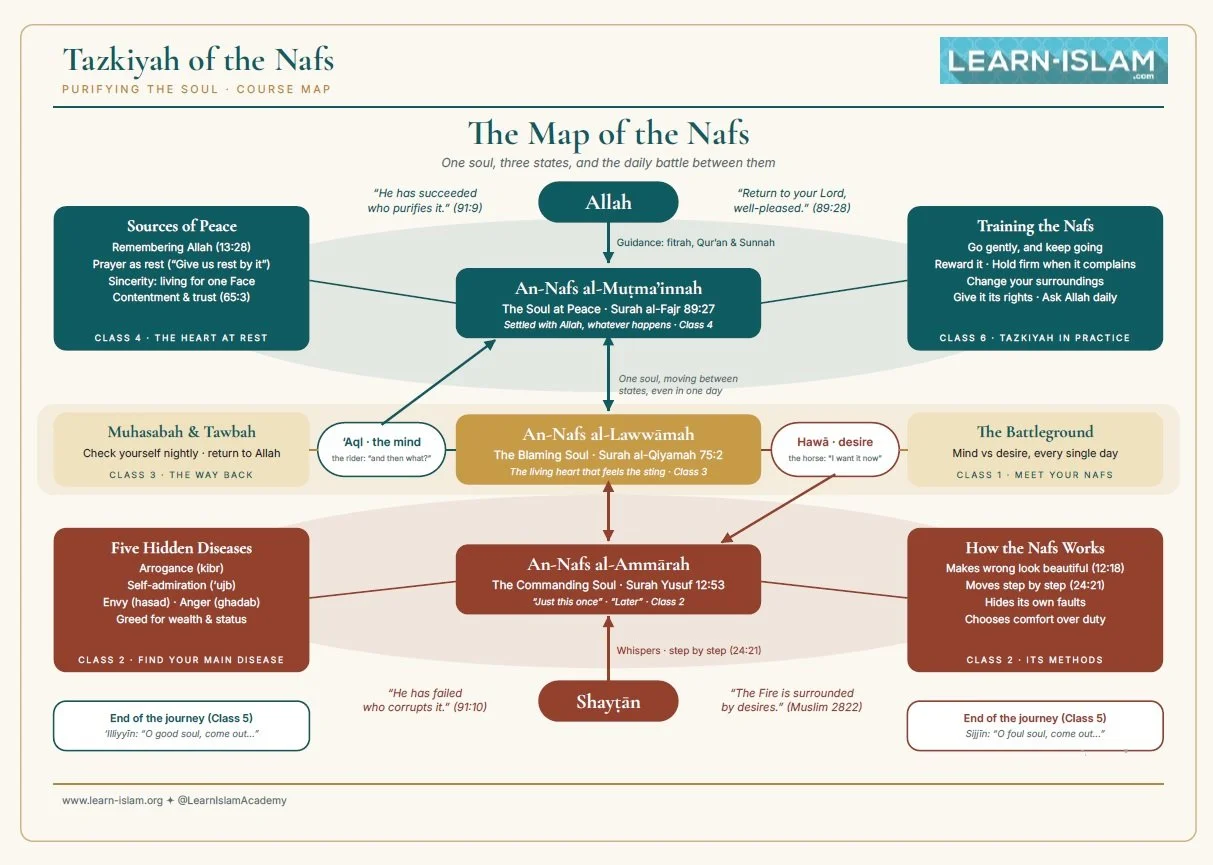
Before we build our plan, look at where we have been. Find yourself on this map. Which state are you in most days? Which box do you need most right now?
THE STRUGGLE IS THE PATH
Allah says, “And those who strive for Us, We will surely guide them to Our ways.” (Surah al-‘Ankabut 29:69)
And the Prophet ﷺ said, “The mujāhid is the one who strives against his own soul for the sake of Allah.” (Jami’ at-Tirmidhi 1621, sahih)
Islam means surrendering your whole self to Allah, not just a part of it. That is why the path of Islam is always a path of struggle. Guidance is a gift from Allah, but we keep it and grow in it only by striving for it. Allah says: “Do you think you will enter Paradise while Allah has not yet made known those of you who strive and those who are patient?” (Surah Al ‘Imran 3:142)
Struggle means sacrifice
Giving up something you love for something better. It is only a sacrifice if you value what you give. The nafs holds on tightly to three things:
Time. Prayer, Qur’an, visiting the sick and serving family all take time. The real sacrifice is not the hours themselves, but what we would have spent them on: the scrolling, the entertainment, the extra sleep.
Wealth. Wealth is not evil; the Qur’an calls it khayr, good. It becomes a problem when a means becomes the goal. Three reminders make giving easier: it all belongs to Allah anyway; it will all be left behind at our last breath; and what we give for Allah comes back many times over. “You will never attain righteousness until you spend from what you love.” (3:92)
Ego and comfort. Saying “I was wrong”, controlling anger, staying quiet when we want to win the argument. Often this is the hardest sacrifice of all.
Examples of Sacrifice
Abu Talhah R.A., when 3:92 was revealed, gave away the garden he loved most. The Prophet ﷺ praised it as “a profitable deal” (Bukhari & Muslim).
Bilal R.A., a slave, was laid on the burning sand of Makkah with a rock on his chest and told to leave Islam. He would only say: “Ahad, Ahad” (One, One). Years later, on the day Makkah was opened, it was Bilal who called the adhan from the Ka’bah.
Their sacrifices were great, and most of us will never be tested the way they were. But we have our own struggle. Every day, the nafs asks us for something, and every day we choose. Do I get up for Fajr, or sleep a little longer? Do I give, or keep? Do I say the angry word, or swallow it? These choices look small, but together they decide what kind of soul we become.
This struggle never ends. There is no day when the nafs stops pulling and we can finally relax. Allah says: “And worship your Lord until there comes to you the certainty” (Surah al-Hijr 15:99), and the scholars explain that the “certainty” is death.
Imam Ahmad was once asked, “When will the servant find rest?” He replied: “With the first step he places in Paradise.”
Rewards of Striving:
Allah rewards the striving, not only the winning. He does not ask us to be perfect. He asks us to keep trying. “Those who strive for Us, We will surely guide them to Our ways” (29:69).
Every struggle has an end, and a reward waiting. Paradise is surrounded by hardships (Muslim 2822). Each hardship you go through for Allah’s sake is a step closer to it. One moment in Jannah will wipe out the memory of every hard day here (Muslim 2807).
The struggle is not the obstacle on the path. The struggle is the path. Keep praying, keep striving, keep doing good.
SIX RULES FOR TRAINING THE NAFS
Rule 1: Go gently, and keep going
Ibn al-Jawzi says the self is trained through gentleness and moving step by step, from one state to the next, not through violence. The person who suddenly decides to pray all night, fast every day and read a juz' daily usually stops within a week.
The Prophet ﷺ said,
"The most beloved of deeds to Allah are the most consistent, even if they are small." (Bukhari & Muslim)
"This religion is easy, and no one makes it hard for himself except that it overpowers him. So aim for what is right, come close to it, and have glad tidings." (Sahih al-Bukhari)
Two rak'ahs every night for a year are better than a hundred rak'ahs for one week and then nothing.
Rule 2: Reward the nafs
Ibn al-Jawzi tells us that some of the righteous predecessors, when they wanted a sweet treat, would promise it to themselves as a reward: "If you pray the night prayer, you can have it." Treat your nafs like a child you are training. Do not only say no. Also give it something halal to look forward to.
Rule 3: Hold firm when it complains
Ibn al-Jawzi narrates that a neighbour of Mālik ibn Dīnār heard him at night saying to himself, "That is how you should be!" The next day he asked him who he was talking to. Mālik said: my self asked me for bread. I refused it for three days. Then I found a dry piece of bread, and was about to say, "Wait, I will get soft bread", but my self said, "I am content with this." So I said to it: "That is how you should be!"
The nafs tests you. It complains, bargains, and asks for more. If you hold firm a little, it learns. Then it becomes content with less.
Thābit al-Bunānī (Tābi'ī) said, I struggled with the night prayer for twenty years, and then I enjoyed it for twenty years.
The struggle does not last forever. What is hard at the start becomes sweet later.
Rule 4: Change your surroundings
No one wins this battle alone, and no one wins it in a bad environment.
The Prophet ﷺ said, "A person is upon the religion of his close friend, so let each of you look at whom he befriends." (Sunan Abi Dawud 4833, hasan)
The Prophet ﷺ compared a good friend to a perfume seller: either he gives you some, you buy some, or at least you leave smelling good. A bad friend is like the blacksmith's furnace: either it burns your clothes, or you leave smelling of smoke (Bukhari & Muslim).
Today our "friends" are also the accounts we follow, the groups we are in, and the apps on our home screen. Ibn al-Jawzi says the cure for a desire is easiest before it becomes deep-rooted, by blocking the way to it. Unfollow, mute, delete, move the phone out of the bedroom.
Allah says, "Tell the believing men to lower their gaze and guard their private parts. That is purer for them." (Surah an-Nur 24:30)
Rule 5: Give the nafs its rights
Ibn al-Jawzi warns: do not forget the rights of the self. If it is denied everything, the heart becomes blind and the person breaks. The Prophet ﷺ told 'Abdullah ibn 'Amr, who wanted to fast every day and pray all night: "Your body has a right over you, your eyes have a right over you, and your wife has a right over you" (Sahih al-Bukhari 1975). Sleep, eat well, rest, laugh with your family. Tazkiyah is not punishment. It is training.
Rule 6: Ask Allah, every day
The Prophet ﷺ began his sermons by seeking refuge in Allah “from the evils of our own souls” (Sunan Abi Dawud 2118, sahih). If he needed to ask, how much more do we? Here are five duas from the Sunnah to make part of your day.
1. For a heart that stays firm
يَا مُقَلِّبَ الْقُلُوبِ، ثَبِّتْ قَلْبِي عَلَى دِينِكَ
Yā muqallibal-qulūb, thabbit qalbī ‘alā dīnik.
“O Turner of hearts, keep my heart firm upon Your religion.” (Jami’ at-Tirmidhi 2140, sahih)
Anas R.A. said the Prophet ﷺ said this often.
2. For a heart that turns toward obedience
اللَّهُمَّ مُصَرِّفَ الْقُلُوبِ، صَرِّفْ قُلُوبَنَا عَلَى طَاعَتِكَ
Allāhumma muṣarrifal-qulūb, ṣarrif qulūbanā ‘alā ṭā’atik.
“O Allah, Turner of hearts, turn our hearts to Your obedience.” (Sahih Muslim)
3. For the four things the nafs needs most
اللَّهُمَّ إِنِّي أَسْأَلُكَ الْهُدَى، وَالتُّقَى، وَالْعَفَافَ، وَالْغِنَى
Allāhumma innī as’alukal-hudā, wat-tuqā, wal-‘afāfa, wal-ghinā.
“O Allah, I ask You for guidance, taqwa, chastity, and contentment.” (Sahih Muslim)
Guidance for the mind, taqwa for the heart, chastity against desire, and contentment against greed.
4. For protection from your own soul (morning & evening)
اللَّهُمَّ عَالِمَ الْغَيْبِ وَالشَّهَادَةِ، فَاطِرَ السَّمَاوَاتِ وَالْأَرْضِ، رَبَّ كُلِّ شَيْءٍ وَمَلِيكَهُ، أَشْهَدُ أَنْ لَا إِلَهَ إِلَّا أَنْتَ، أَعُوذُ بِكَ مِنْ شَرِّ نَفْسِي، وَمِنْ شَرِّ الشَّيْطَانِ وَشِرْكِهِ
Allāhumma ‘ālimal-ghaybi wash-shahādah, fāṭiras-samāwāti wal-arḍ, rabba kulli shay’in wa malīkah, ash-hadu an lā ilāha illā ant, a’ūdhu bika min sharri nafsī, wa min sharrish-shayṭāni wa shirkih.
“O Allah, Knower of the unseen and the seen, Creator of the heavens and the earth, Lord and Owner of everything: I bear witness that there is no god but You. I seek refuge in You from the evil of my own soul, and from the evil of Shaytan and his call to shirk.” (Sunan Abi Dawud 5067, Jami’ at-Tirmidhi 3392, sahih)
The Prophet ﷺ taught this to Abu Bakr. Notice the order: first the evil of my own soul, then Shaytan.
5. For help in worship (after every prayer)
اللَّهُمَّ أَعِنِّي عَلَى ذِكْرِكَ، وَشُكْرِكَ، وَحُسْنِ عِبَادَتِكَ
Allāhumma a’innī ‘alā dhikrika, wa shukrika, wa ḥusni ‘ibādatik.
“O Allah, help me to remember You, to thank You, and to worship You well.” (Sunan Abi Dawud 1522, sahih)
The Prophet ﷺ told Mu’adh ibn Jabal: “Do not leave saying this after every prayer.”
Tip: Don’t try to memorise all five at once. Pick one this week and say it after every prayer. Add another next week. The duas from earlier classes (Muslim 2722, Tirmidhi 3591, Abu Dawud 5090) belong in this list too.
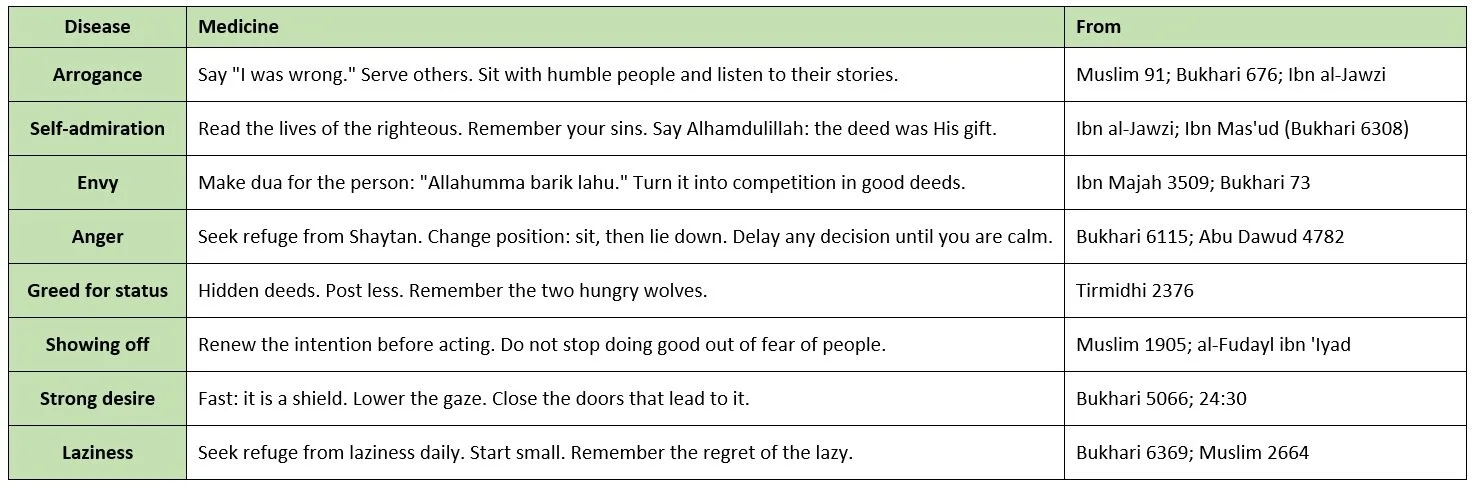
The Medicine Cabinet
In Class 2 we promised to gather the cures. Here they are in one place. Go to the medicine for your main disease first.
YOUR TAZKIYAH PLAN FOR LIFE
Knowledge that stays in a notebook does not change a soul. So before this course ends, each of us needs a plan.
📥 Your gift from this course: the Weekly Practice Sheets. We have prepared a free PDF for you to download. It has one page for each of our six classes, with a 7-day tracker for that week’s practices, a checklist, space for reflection, and the dua of the week.
The course is ending, but the practice is not. Whenever you notice your main disease returning, or your heart becoming restless, print that class’s sheet and repeat the week. Anger returning? Do the Class 2 sheet again. Feeling far from Allah? Do Class 4 again. Use these six pages as your toolkit for life.
The last page is My Tazkiyah Plan for Life. Fill it in today, while the course is fresh in your heart.
FOUR RULES FOR A PLAN THAT LASTS:
Keep it small. Write a plan you can keep on your worst day, not your best. If you are tired, sick or busy, can you still do it? If not, make it smaller. “The most beloved of deeds to Allah are the most consistent, even if they are small.” (Bukhari 6464, Muslim 783)
Build on your notebook. Look back at pages 1 to 5. Your main disease from Class 2 tells you which medicine to put in your plan. Your peace map from Class 4 tells you which habits to protect. Your letter from the grave in Class 5 tells you what matters most.
Be specific. “Read more Qur’an” is a wish. “One page after Fajr” is a plan.
Choose one person to check on you. Write their name on the sheet and ask them to message you once a month: “How is your plan going?” No one wins this battle alone.
When you fall
You will fall. Everyone does. When it happens, remember Class 3: do not let the sin stop your repentance. Repent, do a good deed straight after, and return to your plan the same day. The plan is not broken when you miss a day. It is only broken when you stop.
Al-Hasan al-Basri said: “O son of Adam, you are nothing but a number of days. Whenever a day passes, a part of you has gone.” (Reported by Abu Nu’aym in Ḥilyat al-Awliyā’)
The Final Mirror
Which class affected me the most, and why?
In Class 1, which state of the nafs was winning in my life? Which one is winning now?
What has changed in my main disease since Class 2?
Which one habit from this course will I keep for the rest of my life?
If I could only remember one sentence from this course, what would it be?
Closing Dua: Where We Began
We began this course with a dua. We end it with the same dua, but now we understand every word of it. The Prophet ﷺ used to say:
اللَّهُمَّ آتِ نَفْسِي تَقْوَاهَا، وَزَكِّهَا أَنْتَ خَيْرُ مَنْ زَكَّاهَا، أَنْتَ وَلِيُّهَا وَمَوْلَاهَا
Allāhumma āti nafsī taqwāhā, wa zakkihā anta khayru man zakkāhā, anta waliyyuhā wa mawlāhā.
"O Allah, give my soul its taqwa, and purify it, for You are the best to purify it. You are its Protector and its Master.” (Sahih Muslim 2722)
Nafsī: my soul, the one we met in Class 1. Zakkihā: purify it, the tazkiyah we have been working on. Anta waliyyuhā: You are its Protector, because without Allah the nafs is left to itself.
Make this dua every day for the rest of your life. The course is finished. The work has just begun.
قَدْ أَفْلَحَ مَن زَكَّىٰهَا
"He has succeeded who purifies it." (91:9)
May Allah make us among them. Ameen.
SUPPORT LEARN ISLAM
Alhamdulillah we have been providing free courses on LEARN ISLAM for over 15years now. We now have employees working in our organisation and need support to fulfil commitments and accomplish goals/projects.
Support LEARN ISLAM in continuing to provide free courses on
Quran & Tajweed.
Various Islamic Topics.
Parenting.
Worldly Skills (like Designing, Excel Sheets etc).
Free Matrimonial Services.
More Projects coming up InShaAllah.
TIPS FOR THE TEST
Do not have to memorise the ayahs or hadeeths word for word and their references, but remember their meanings and the msg being given.
Memorise the Duas (atleast 2).
Remember the step to be taken.
Remember the what brings peace.
ASSIGNMENT
There will be an Assignment Question asked in the Test. Marks will be given based on the following: -
I. Invite atleast 10 people to the course (can invite via WhatsApp, Facebook, Email, telegram or word of mouth) 4 Marks. (check the note below for exceptions)
Note:
Those who have already invited whether on Whatsapp, Email or FB, do not need to invite again.
It does not matter, whether people join or not, our job is to invite.
II. Talk to 3 people (friends or family) about any three topics from the course - (5 Marks)
III. Pray for the Ummah, pray for the ease of all the poor & oppressed Muslims and Maghfirah of the Muslims who passed away. Pray that Allah make us all strong in imaan and give us the hidayah to work for the aakhirah and to help each other. - 1 Mark
JOIN FOR FREE VIA
WHATSAPP | TELEGRAM | EMAIL
Pls read our FAQs to get the details and to know how we go about things if U have any further Qs pls feel free to ask...
FAQs: - https://learn-islam.org/faqs-week-course
Happy Learning... JazakAllah Khair...
As Salam Alaikum Wa Rahmatullaahi Wa Barakaatuh :)